How to Plan a Luxury Journey Across the Gulf
A private aircraft arrives in Dubai on time, but the chauffeur has been sent to the wrong airport. A hotel in Riyadh is confirmed, but the airport transfer was arranged for a commercial terminal instead of the private aviation facility. A yacht is reserved in Dubai, but its departure time does not account for the guests’ arrival process.
Every individual service may be premium, yet the complete journey can still feel disconnected.
Planning luxury travel in the Gulf involves more than reserving an expensive flight, car or hotel. The airport, vehicle, accommodation, meetings, events and leisure experiences must all operate as parts of one itinerary.
A well-planned journey should feel simple to the traveller because the timings, handoffs and travel details have already been coordinated.
Key Takeaway
Luxury Gulf travel planning connects every stage of the journey, from private aviation and airport handling to chauffeur-driven vehicles, hotels, yachts and group transportation.
The most important requirements are accurate passenger information, realistic transfer times, suitable aircraft and vehicle capacity, and one clear point of coordination.
Why Gulf Travel Requires Connected Planning
The Gulf is well connected by air and road, but a multi-city or multi-country itinerary can quickly become complicated.
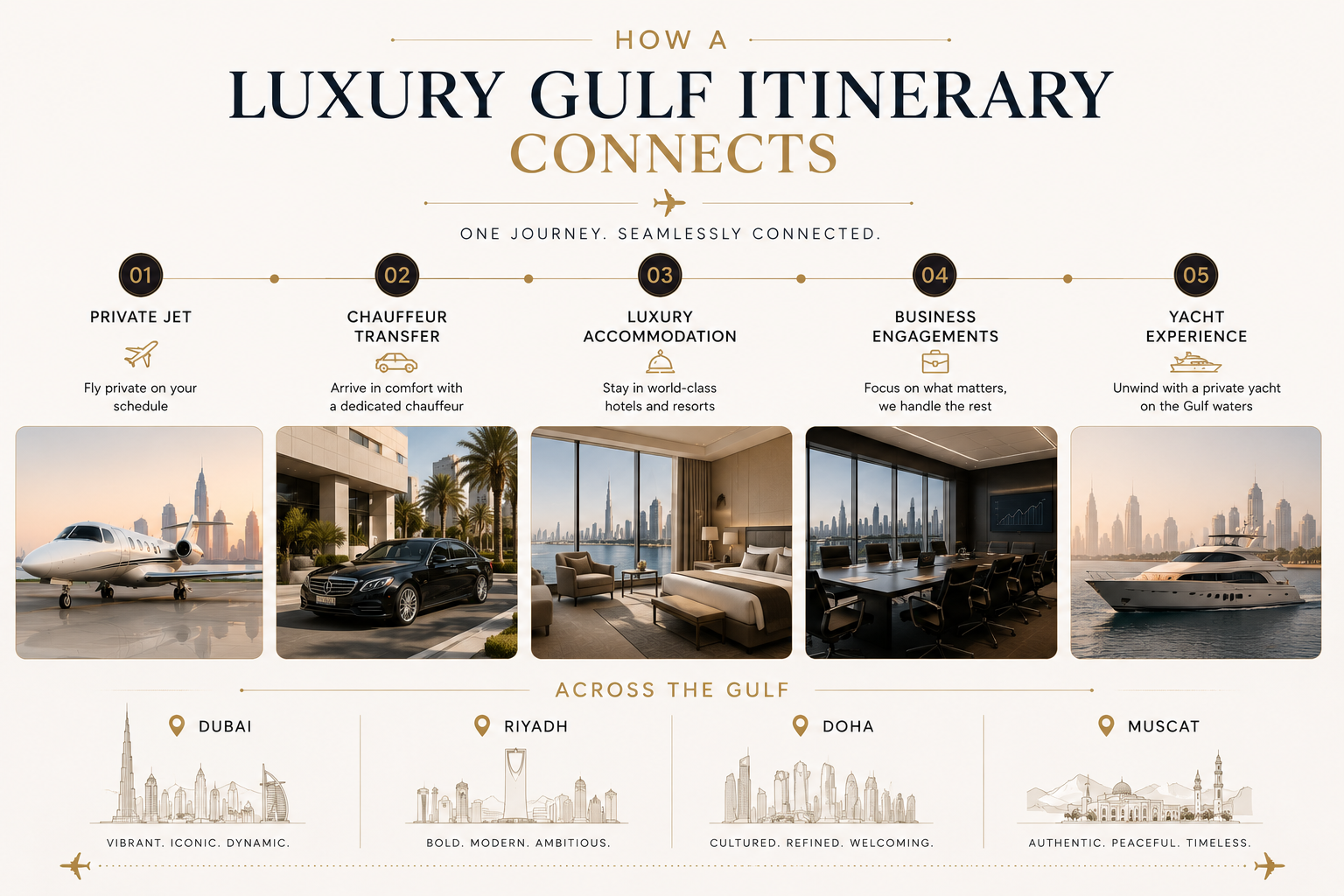
A traveller may arrive by private jet in Dubai, attend meetings in Riyadh, continue to Doha and finish the journey with a short leisure stay in Muscat. Each city has different airports, traffic patterns, entry requirements, private aviation facilities and transportation arrangements.
Problems often appear when every service is booked separately. The chauffeur may not receive an updated arrival time. The aircraft operator may not know how much luggage the passengers are carrying. The event transport team may not have the final guest list.
Connected planning places these details within one master itinerary. Every confirmed provider receives the information relevant to their part of the journey.
What Does a Gulf Travel Concierge Coordinate?
A travel concierge supports the practical connection between flights, airports, transportation, accommodation and scheduled experiences.
Depending on the journey, the concierge may coordinate a bespoke itinerary, private jet charter, VIP airport assistance, chauffeur-driven vehicles, corporate transport, yacht hire and on-trip support.
The concierge does not replace the airline, aircraft operator, immigration authority, hotel or activity provider. The role is to ensure that confirmed services connect properly and that relevant updates reach the right people.
Gulf Travel Solutions provides premium travel services across the Gulf for individuals, families, executives and corporate groups.
Start with the Purpose of the Journey
The itinerary should be designed around why the passenger is travelling.
A business traveller may need flexible departure times and direct airport-to-meeting transportation. A family may require larger vehicles, child seats and more luggage space. A corporate delegation may need several vehicle types and a passenger manifest connecting every guest to a flight, chauffeur and hotel.
Before any service is confirmed, the planner should understand the destinations, dates, passenger count, luggage, meeting times, preferred privacy level and expected travel experience.
These details determine whether the journey requires a private aircraft, commercial flight, luxury sedan, SUV, premium van or executive coach.
Building a Bespoke Gulf Itinerary
A bespoke itinerary should follow the order in which the traveller will experience the journey.
It begins with the arrival airport. The plan should identify the terminal or private aviation facility, expected clearance process, meet-and-greet arrangements and chauffeur collection point.
The next stage is the transfer to the hotel, residence or meeting venue. Travel time should account for immigration, baggage, road traffic and destination entry procedures.
Meetings, dining reservations and leisure activities should be placed around realistic travel times. A flight landing at a particular time does not mean the passenger will immediately be inside the waiting vehicle.
For multi-country journeys, the plan should confirm whether each sector will be completed by private aircraft, commercial flight or road. Passenger documents and entry requirements must be checked for every destination.
Travellers can explore the Gulf destinations covered by Gulf Travel Solutions when considering a regional itinerary.
Planning Private Aviation Across the Gulf
Private aviation can reduce dependence on fixed airline schedules and make complex journeys easier to organise.
It may be useful when several cities must be visited within a short period, commercial schedules do not match meeting times or a group needs to remain together. It can also support travellers who require greater privacy or need to carry specialist equipment.
Aircraft selection depends on route length, passenger count, luggage and cabin requirements. A short flight between Gulf cities may suit a light or midsize jet. A longer international route may require a heavy or ultra-long-range aircraft.
Travellers can compare popular private jet routes from Dubai before deciding which aircraft category could suit their itinerary. The guide covers Dubai to Jeddah, Dubai to Singapore and Muscat to Kuwait.
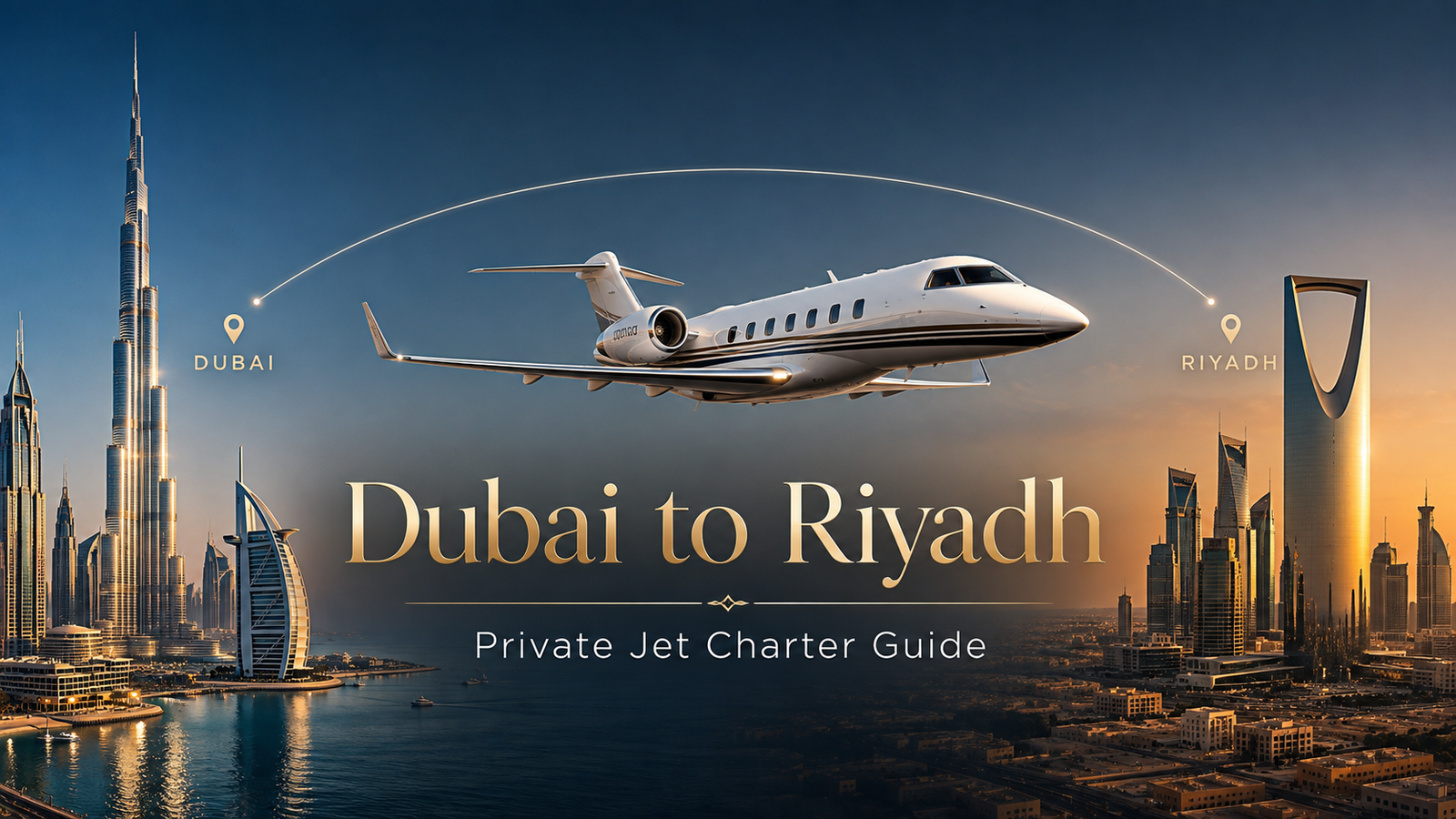
For a route-specific example, the Dubai to Riyadh private jet charter guide explains aircraft, airport and pricing considerations.
Aircraft availability and charter arrangements can be discussed through the private jet charter service.
Coordinating VIP Airport Services
The airport experience should be planned with the same care as the flight.
VIP airport support may include private-terminal access, meet-and-greet assistance, expedited processing where available, immigration and customs coordination, baggage handling and access to a passenger lounge.
These services vary by airport, terminal and package. They should be confirmed before the passenger travels.
Passengers flying through Dubai South can read the guide to VIP and premium services at Al Maktoum Airport for more information about DWC private terminals, security processing and customs assistance.
Connecting the Private Jet with the Chauffeur
The handoff between a private aircraft and the waiting chauffeur is one of the most important stages of the itinerary.
The transfer team needs the correct airport, aircraft registration, arrival time, FBO or handling company, passenger contact details and luggage information.
Aircraft-side pickup should not be assumed. Access depends on airport security, FBO procedures and prior approval. When direct access is unavailable, passengers may complete the required procedures inside a private terminal before meeting the chauffeur at a designated collection point.
The guide to arranging a private jet airport transfer in Dubai explains how this handoff works.
Passengers arriving on commercial or private flights can also review the broader VIP airport transfer guide for Dubai.
Choosing the Right Chauffeur-Driven Vehicle
The vehicle should suit the passenger, luggage and purpose of the journey. Selecting a car based only on appearance can create practical problems when the passengers leave the airport.
Traveller Profile | Suitable Vehicle Plan |
Individual executive | Premium sedan |
Couple or two VIP passengers | Luxury sedan or SUV |
Family with several suitcases | Luxury SUV or premium van |
Senior executive with security | Principal vehicle with support SUV |
Small business group | Premium van or several executive cars |
Large delegation | Executive coaches and a mixed vehicle fleet |
A vehicle’s seating capacity does not guarantee enough luggage space. Passenger seats and baggage capacity should be considered separately.
Travellers can explore available luxury cars in Dubai or review the requirements for luxury car rental in Dubai before requesting a particular model.
Planning Corporate Travel Across the Gulf
Corporate travel may involve senior leaders, employees, event guests, security teams and technical staff arriving on different flights.
A reliable itinerary should connect every traveller to the correct airport, chauffeur, hotel, meeting and onward journey. A passenger manifest can be used to record each person’s flight, terminal, assigned vehicle, contact number and destination.
Senior guests may travel in premium sedans, while employees and event teams use vans or executive coaches. Security personnel and luggage may require additional vehicles.
Companies can compare a corporate coach with a multi-vehicle fleet before deciding how to move a delegation.
For larger groups, premium bus transportation can be included in the wider corporate itinerary.
Adding a Yacht Experience
A private yacht may be included for a family celebration, corporate gathering or leisure experience.
The booking should consider the guest count, departure marina, charter duration, catering, entertainment and transport to and from the marina. The itinerary must also allow enough time for guests to travel from the airport or hotel before boarding.
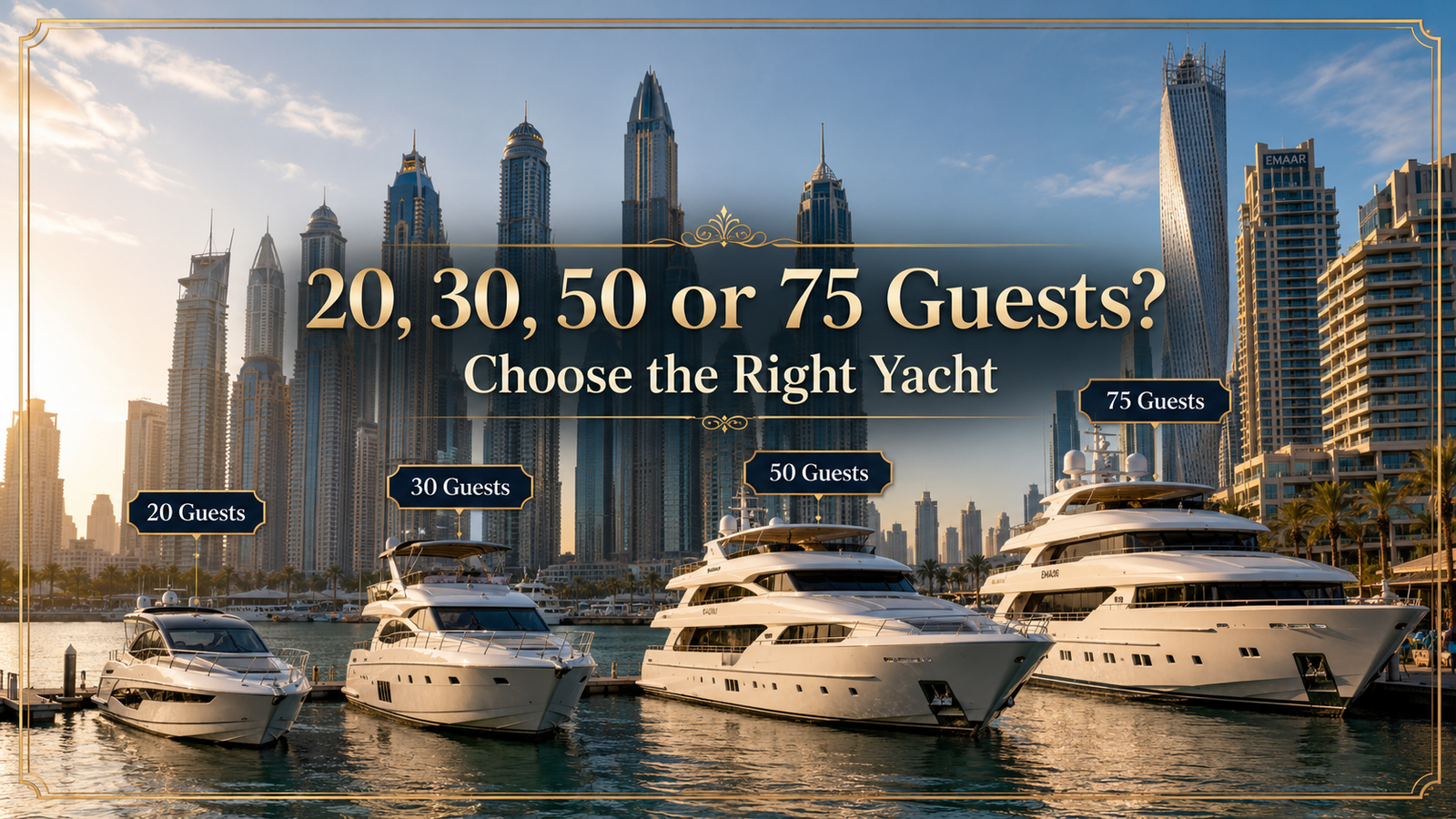
The number of guests affects the required yacht size. A yacht selected only for its appearance may not provide enough seating, dining space or open areas for the planned event.
The guide to choosing a Dubai yacht rental by guest count compares suitable yacht capacities for different group sizes.
Travellers can also explore the available yacht hire options.
Three Examples of Connected Gulf Travel
A Regional Executive Journey
An executive arrives by private jet at DWC and travels directly to a meeting in Dubai. The following morning, the same traveller flies to Riyadh before continuing to Doha.
The itinerary must coordinate private aviation, DWC passenger handling, chauffeur transportation and realistic meeting times in each city.
A Family Luxury Holiday
A family arrives at DXB, transfers by luxury SUV to a hotel and joins a yacht charter the following day. They later continue to a resort in another Gulf destination.
The plan must account for luggage, child seats, hotel check-in, marina arrival time and the return flight.
A Corporate Delegation
A leadership group and support team arrive on several flights. Senior executives travel in premium sedans, while employees and event materials are transported in coaches and luggage vehicles.
A detailed passenger manifest connects every traveller to a flight, chauffeur, vehicle and hotel.
Should You Use One Coordinator or Several Providers?
Travellers can book each service independently or use one point of coordination.
Independent booking provides direct control over every reservation. However, the traveller or executive assistant becomes responsible for sharing schedule changes with the aircraft operator, chauffeur, hotel, yacht company and other providers.
One coordinator becomes useful when the journey includes several countries, passengers arriving separately, private aviation, multiple vehicle categories or a tightly timed event schedule.
The right approach depends on the complexity of the journey rather than the total number of bookings.
What Affects the Cost of Luxury Gulf Travel?
The final cost depends on the route, season, aircraft, accommodation, transportation and required level of support.
Private aviation pricing can be affected by the aircraft category, flight time, positioning and airport handling. Ground transportation depends on the vehicle type, number of vehicles, distance, waiting time and additional stops. Yacht pricing is influenced by the vessel size, charter duration, catering and onboard requirements.
Security arrangements, meet-and-greet services and last-minute itinerary changes may also affect the cost.
A quotation should explain what is included and identify any services that could result in additional charges.
The cheapest individual reservations may not produce the best complete itinerary if they create long waits, unsuitable connections or repeated transfers.
Information Needed to Plan the Journey
Before contacting a Gulf travel agency or travel concierge, prepare the travel dates, cities, passenger count, passport nationalities, luggage details, hotel preferences and meeting times.
The coordinator should also know whether private aviation, VIP airport support, chauffeur-driven vehicles, group transportation or leisure experiences are required.
Sharing a realistic budget range helps the planner recommend appropriate aircraft, vehicles and accommodation without creating an itinerary that cannot be confirmed.
Create One Journey, Not a Collection of Bookings
Luxury travel is not defined only by the aircraft, car, hotel or yacht. It is defined by how well every stage works together.
The passenger should know who will meet them, where they are going and what happens next. The chauffeur should have the correct arrival details. The aircraft team should understand the passenger and luggage requirements. Every provider should be working from the same itinerary.
Gulf Travel Solutions coordinates travel solutions across the Gulf for individuals, families, executives and corporate groups.
Contact Gulf Travel Solutions with your destinations, dates, passenger count and service requirements to begin planning the journey.
Frequently Asked Questions
What does a luxury travel concierge do?
A luxury travel concierge coordinates different stages of a journey, including flights, airport services, chauffeur transportation, accommodation, yachts and scheduled experiences.
Can one itinerary include several Gulf countries?
Yes. A multi-country itinerary can include destinations across the UAE, Saudi Arabia, Qatar, Bahrain, Kuwait and Oman, subject to availability and entry requirements.
Can private jets and chauffeur services be booked together?
Yes. A private aircraft arrival can be coordinated with the FBO, meet-and-greet representative and chauffeur-driven vehicle.
Is a concierge useful for corporate travel?
Yes. Concierge coordination can be valuable when executives, employees and support teams arrive on different flights or require several vehicle categories.
What information is needed to plan luxury Gulf travel?
The planner generally needs the travel dates, destinations, passenger count, flight requirements, luggage, hotel preferences, scheduled activities and transportation needs.